
At 2:13 AM, in the heart of a high-density urban cluster, the silence of a Network Operations Center (NOC) is broken by a cascade of crimson alerts. A critical tower site is reporting fluctuating power levels and significant packet loss. Within minutes, subscribers in a three-kilometer radius begin experiencing dropped calls and stuttering data streams.
For the Network Operations Head, this isn’t just a technical glitch, it is a ticking clock. Every minute of instability threatens stringent Service Level Agreement (SLA) commitments, degrades the customer experience, and inflates operational expenditure. In India’s hyper-competitive landscape, where 5G demands near-zero latency, the difference between a minor incident and a brand-damaging outage lies in the efficiency of telecom O&M services.
Maintaining network uptime in India requires more than just reactive fixes; it demands a disciplined, 24×7 integrated approach to infrastructure health.
What are O&M Services in Telecom?
In the simplest terms, operations and maintenance telecom (O&M) is the functional backbone that keeps a network alive. While “deployment” focuses on building the network, O&M focuses on sustaining its performance throughout its lifecycle.
Telecom O&M services in India involve a dual-pronged approach to infrastructure:
- Passive Infrastructure Maintenance: Ensuring the physical environment is stable. This includes tower structures, Power Purchase Agreements (PPA), Diesel Generators (DG), battery banks, and air conditioning units (HVAC) that keep sensitive electronics from overheating.
- Active Infrastructure Maintenance: Managing the “intelligent” side of the network – the Base Transceiver Stations (BTS), antennas, microwave links, and backhaul fiber that transmit data.
Why Continuous Monitoring is Non-Negotiable
Modern networks are too complex for manual oversight alone. A single site failure can trigger a domino effect across neighboring cells. Continuous monitoring ensures that anomalies are detected before they manifest as outages. For an operator, telecom O&M services India represents the primary defense against “silent failures”, issues like degrading battery health or fiber micro-bends that don’t cause an immediate crash but slowly erode network quality.
Preventive vs. Corrective vs. Predictive Maintenance
To achieve high-tier network uptime India, managed service providers like Vedang utilize a three-layered maintenance strategy.
Preventive Maintenance (The Shield)
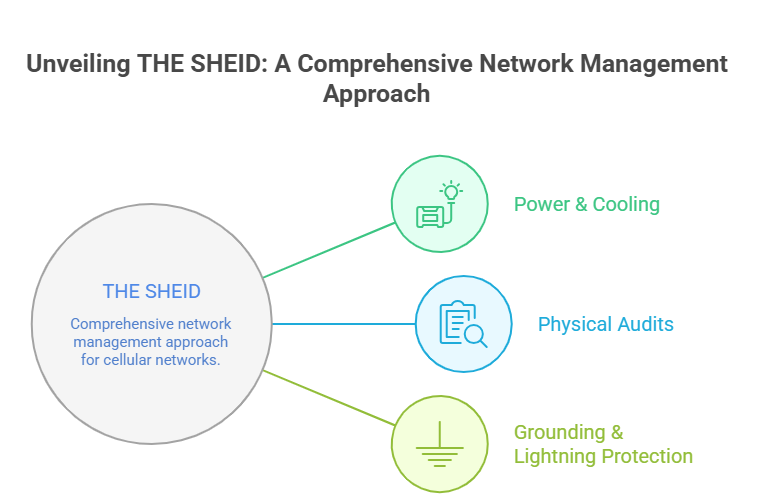
Preventive maintenance is the scheduled, proactive “health check” of the network. It is designed to prevent wear and tear from escalating into failure.
- Power & Cooling: Regular verification of battery backup health and cooling system efficiency to prevent thermal shutdowns.
- Physical Audits: Inspecting tower bolts for corrosion and ensuring fiber optic cables are securely routed.
- Grounding & Lightning Protection: Crucial in the Indian context to protect multi-million dollar equipment from monsoon-related surges.
Corrective Maintenance (The Response)
Despite the best planning, hardware fails. Corrective maintenance is the “break-fix” workflow triggered by a network alarm.
- Fault Restoration: Rapid dispatch of field engineers to replace faulty RRUs (Remote Radio Units) or repair fiber cuts.
- Emergency Restoration: Deploying mobile backup solutions (COWs – Cell on Wheels) during catastrophic failures to maintain basic connectivity.
Predictive Maintenance (The Intelligence)
This is the evolution of O&M. By leveraging AI/ML-driven anomaly detection and historical KPI monitoring telecom, teams can identify patterns that precede a failure.
Operational Fact: Predictive maintenance reduces unplanned outages by up to 35% by allowing engineers to replace a failing component during a scheduled maintenance window rather than during an emergency midnight outage.
Key Telecom O&M Activities: Engineering Precision
Operational excellence is built on a foundation of repeatable, documented processes.
Alarm Handling and Incident Management
The NOC is the “brain” of the operation. Every alarm is categorized by severity (Critical, Major, Minor).
- Root Cause Analysis (RCA): We don’t just clear the alarm; we find out why it happened. Was it a grid power fluctuation or a hardware defect?
- Escalation Workflows: Ensuring that the right specialist, whether a fiber splicer or a power technician, is on-site within the stipulated Mean Time to Repair (MTTR).
Rigorous Site Audits
Beyond the digital data, physical site audits verify that the asset lifecycle is being tracked accurately. This includes compliance inspections and safety verification to ensure that every site meets national regulatory standards.
KPI Monitoring: The Metrics of Success
In telecom O&M services India, performance is measured through hard data. Key Performance Indicators (KPIs) tracked include:
- Network Availability: The percentage of time the network is fully operational.
- Call Drop Rate (CDR): A direct reflection of radio network health.
- MTTR (Mean Time to Repair): The speed of the corrective response.
- Latency & Packet Loss: Critical for 5G and enterprise-grade leased lines.
The Role of AI/ML and Remote Monitoring
The “man-with-a-wrench” model is no longer sufficient for 5G scales. Modern O&M has evolved into Intelligent Operations.
By integrating Remote Network Operations Centers (NOCs), Vedang enables real-time visibility across thousands of geographically dispersed sites.
- AI-Driven Fault Detection: Algorithms can now distinguish between a “nuisance alarm” (caused by temporary interference) and a genuine hardware failure, reducing unnecessary field visits by up to 20%.
- Remote Troubleshooting: Many software-side issues can be resolved from the NOC without sending a technician to the site, drastically reducing the carbon footprint and resolution time.
- Automated Escalation: If an alarm isn’t acknowledged within a specific timeframe, the system automatically alerts the next level of management, ensuring total accountability.
The High Cost of Failure: 5 Consequences of Poor O&M
Neglecting operations and maintenance telecom protocols leads to more than just bad signals; it leads to business erosion.
- Increased Network Downtime: Without preventive checks, hardware failure rates skyrocket.
Stat Anchor: Network downtime costs telecom operators $100K+ per hour on average during peak usage. - SLA Breaches and Financial Penalties: For B2B and wholesale clients, uptime is legally mandated.
Stat Anchor: SLA breaches result in penalties averaging 5–10% of contract value, eating directly into profit margins. - Higher Operational Costs: Emergency “firefighting” is always more expensive than planned maintenance. The cost of last-minute logistics and expedited parts is a heavy burden.
- Customer Dissatisfaction and Churn: In a port-ready market, subscribers will not tolerate persistent call drops. Poor O&M is the fastest way to lose market share to competitors.
- Reduced Infrastructure Lifespan: Equipment that isn’t maintained (e.g., dusty filters, unmonitored power surges) fails years before its intended end-of-life, forcing premature and expensive CapEx outlays.
How Vedang’s 24×7 O&M Model Works
Vedang Corp positions itself as more than a vendor; we are an operational partner integrated into the lifecycle of your network. Our O&M model is built for the scale and complexity of the Indian terrain.