
At sunrise, multiple telecom deployment teams are moving simultaneously across different circles in India. One crew is conducting rooftop structural surveys in a dense Mumbai metro pocket, another is integrating Massive MIMO radios at a highway corridor tower in Uttar Pradesh, while engineers inside a centralized Network Operations Center (NOC) monitor live integration status and pending alarms in real-time. Across the country, thousands of sites are being prepared, upgraded, tested, and optimized, all under aggressive rollout deadlines.
This is the reality of the 5G network rollout in India. It is a transformation of unprecedented scale, moving faster than any previous technology generation. However, for telecom operators and OEM partners, the success of this transition isn’t just about the volume of radios installed. It is an intricate orchestration of multi-vendor integration, site readiness, spectrum alignment, power management, and rigorous compliance checks across one of the world’s most diverse geographies.
As India matures into a global 5G leader, the focus has shifted from mere “coverage” to “capacity and densification.” Achieving this requires a partner who understands that a 5G site is only as good as its integration and its adherence to the underlying infrastructure realities of the Indian landscape.
India’s 5G Rollout Scale and Timeline
The rapid expansion of 5G in India has set global benchmarks for speed. What began as a localized launch has quickly evolved into a massive, nationwide network expansion. By early 2026, the landscape of Indian telecommunications has shifted from initial network coverage deployment to high-density capacity upgrades and optimization.
The Push for Nationwide Expansion
The primary driver behind the 5G network rollout in India is the exponential demand for high-capacity data. With the rise of Fixed Wireless Access (FWA) and enterprise-grade private networks, operators are under immense pressure to maintain 99.9% uptime while expanding into semi-urban and rural circles.
- Urban Priorities: Initial phases focused on “Tier-1” cities and high-traffic hubs where 4G congestion was highest.
- Rural Penetration: The current phase involves expanding the 5G footprint into the hinterlands, necessitating robust backhaul and creative power solutions.
- Infrastructure Density: Unlike 4G, 5G requires a significantly higher number of touchpoints to maintain the promised throughput and low latency.
Industry Benchmark: India is targeting 1 lakh+ 5G sites across all circles by 2026, a goal that necessitates a flawless 5G infrastructure rollout strategy involving thousands of field engineers and precise logistical coordination.
5G Rollout Lifecycle: From Planning to Optimisation
A successful 5G deployment is a sequential, high-precision lifecycle. Any friction in one stage inevitably cascades into delays and cost overruns in the next. At Vedang, we view this lifecycle as a disciplined engineering process.
Phase I: Network Planning
Modern 5G network planning is data-driven. It involves:
- RF Planning: Utilizing advanced propagation models to determine the ideal placement of mid-band and mmWave radios.
- Capacity Estimation: Predicting user density to prevent “cell breathing” and congestion.
- Backhaul Readiness: Ensuring that the site is fed by high-capacity fiber or high-throughput E-band microwave links.
Phase II: Site Survey & Readiness
Before a single piece of equipment arrives, the site must be validated.
- Structural Feasibility: Can the existing tower or rooftop handle the additional weight and wind load of Massive MIMO antennas?
- Power Audits: 5G equipment has higher power draws. Upgrading SMPS (Switched-Mode Power Supply) and battery backups is often a prerequisite.
- Regulatory Permissions: Securing Right of Way (RoW) and SACFA clearances to ensure the site is legally compliant.
Phase III: Installation & Deployment
The physical execution stage involves mounting the Active Antenna Units (AAU) and Remote Radio Heads (RRH).
- Cabling: Replacing legacy cables with high-grade optical fiber and DC power cables.
- Small Cell Strategy: In dense urban environments, macro sites are supplemented by small cells.
Operational Reality: 5G small cell density is 4–5× higher than 4G macro sites, making field coordination and logistics the most critical variables in the deployment equation.
If your partner lacks the technical depth to integrate these complex layers, your 5G investment becomes “expensive 4G.” Whether it is a national circle launch or a private network for a smart factory, your rollout partner must function as an operational extension of your internal engineering team.
Phase IV: 5G Site Integration India
This is where hardware becomes a network. 5G site integration in India involves:
- OEM Configuration: Scripting and loading parameters specific to the vendor (e.g., Nokia, Ericsson, or Samsung).
- Synchronization: Aligning the site with the Grandmaster Clock for precise TDD (Time Division Duplexing) timing.
- Alarm Testing: Verifying that all external and internal alarms are reporting correctly to the NOC.
Phase V: Optimisation & Acceptance
The final stage ensures the site delivers the promised KPIs.
- Drive Testing: Physical verification of signal strength (RSRP), quality (RSRQ), and signal-to-noise ratio (SINR) across the coverage area.
- Benchmark Testing: Comparing actual throughput against the planned Gbps targets.
Top 5 Challenges in 5G Deployment in India
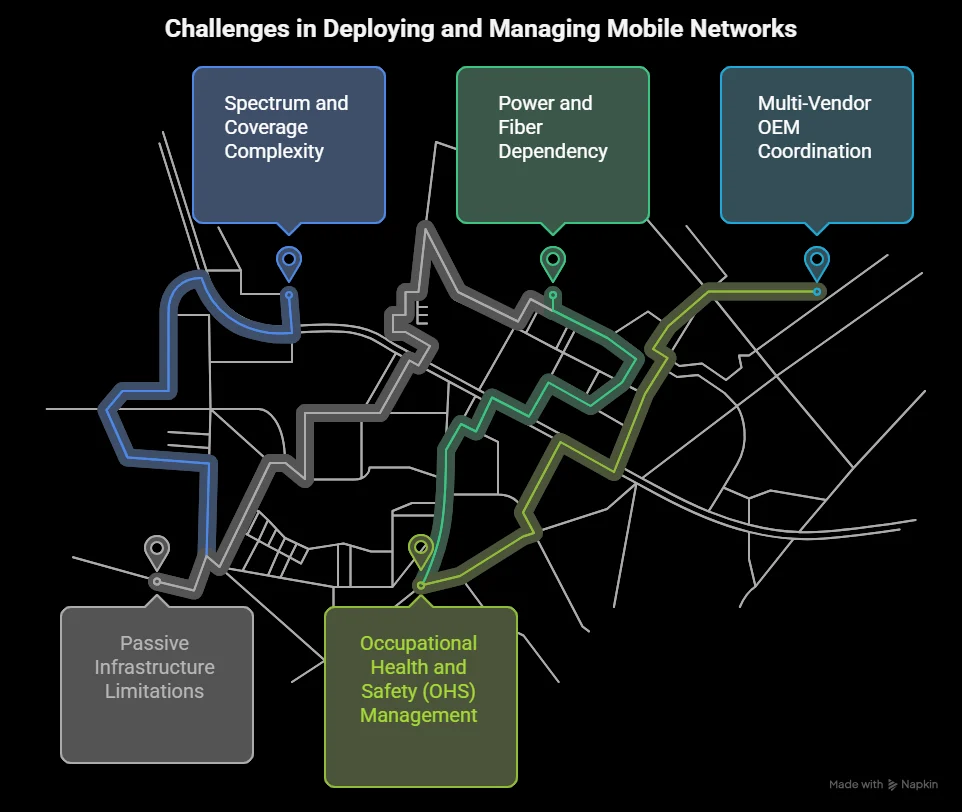
- Spectrum and Coverage Complexity: Managing the propagation characteristics of the 3.5 GHz band through India’s dense concrete urban architecture requires more precise antenna tilting and tuning than 4G.
- Passive Infrastructure Limitations: Many existing towers are reaching their structural “loading limit.” Upgrading these sites requires significant engineering interventions or the deployment of “lean” poles.
- Power and Fiber Dependency: 5G’s performance is tethered to fiberization. With India’s tower fiberization still maturing, the reliance on high-capacity microwave backhaul creates a bottleneck in heavy rain or high-interference zones.
- Occupational Health and Safety (OHS) Management: With thousands of technicians working at height, maintaining zero-incident safety standards across 22 circles is an immense logistical and cultural challenge.
- Multi-Vendor OEM Coordination: Most Indian operators use a mix of OEMs. Ensuring that a site integrated with “Vendor A” hardware handovers seamlessly to “Vendor B” hardware requires high-level technical expertise.
Operational Impact: Deployment errors cost operators an average of 18% in rework expenses, emphasizing the need for “First Time Right” (FTR) execution.
These are the primary challenges of 5G deployment in India that a specialized partner must mitigate.
OEM-Agnostic Advantage in Multi-Vendor 5G Environments
In the current Indian telecom landscape, “vendor lock-in” is a risk operators can no longer afford. Most large-scale networks are heterogeneous environments where equipment from different global OEMs must coexist and communicate.
An OEM-agnostic partner provides the flexibility to deploy and integrate hardware regardless of the brand. This is critical for:
- Standardized Quality: Whether it’s a Massive MIMO radio from one vendor or a baseband unit from another, the installation and safety standards remain uniform.
- Interoperability Management: Expertise in multiple software environments allows for faster troubleshooting during the integration phase.
- Scalability: Operators can pivot between vendors based on supply chain availability without needing to retrain their entire field force.
By removing the friction of vendor-specific silos, operators can accelerate their rollout timelines and reduce the overhead of managing multiple specialized contractors.
Drive Tests, EMF Compliance & Network Assurance
Quality assurance in 5G is a continuous cycle, not a one-time event. As the network grows, ensuring safety and performance becomes a regulatory and operational necessity.
Drive Testing & Throughput Validation
Drive tests are the ground truth of network performance. In the 5G context, this involves more than just “bars on a phone.” It includes:
- Mobility Testing: Ensuring calls and data sessions don’t drop when moving between 5G cells or falling back to 4G ($HO$ success rate).
- Latency Checks: Critical for 5G use cases like cloud gaming or industrial automation.
EMF Compliance & Safety
Electromagnetic Field (EMF) compliance is strictly monitored by the Department of Telecommunications (DoT). Every 5G site must undergo:
- Radiation Measurements: Ensuring the site operates within the safe limits prescribed by ICNIRP.
- Compliance Documentation: Maintaining a digital paper trail for regulatory audits to avoid heavy penalties and site shutdowns.
Network Assurance
Post-deployment, the focus shifts to “Network Health.” This involves real-time alarm monitoring and KPI validation to ensure that the site doesn’t just “stay up” but actually performs at peak efficiency.
How Vedang Executes 5G Rollouts at Scale
Positioned as a premier partner for 5G deployment services in India, Vedang Corp (a Bluspring company) brings a level of discipline and scale that few can match. We don’t just provide “manpower”; we provide a managed ecosystem for infrastructure excellence.
- Pan-India Coordination: Operating across all 22 telecom circles, we manage the complex logistics of moving equipment and personnel to the most remote corners of the country.
- Field Workforce Discipline: Our teams are trained in “First Time Right” (FTR) protocols, significantly reducing the 18% rework cost typically seen in the industry.
- Digitized Project Management: We use real-time tracking and digital site folders to provide operators and OEMs with 100% visibility into the rollout status.
- Safety First: With ISO certifications in OHS and Quality Management, we ensure that the 5G infrastructure rollout is as safe as it is fast.
Whether it is conducting the initial structural survey or performing the final drive test for acceptance, Vedang’s OEM-agnostic approach ensures your network is built for the future.