
The rollout of 5G infrastructure has transitioned from a simple procurement formality into one of the most high-stakes strategic decisions a leadership team will make. In 2026, the global telecom landscape is no longer defined by the race for basic coverage, but by the race for monetization and performance. In India, a market that serves as the world’s most rigorous testing ground, the standards for infrastructure have been forged under extreme competitive pressure.
For Enterprise leaders evaluating Private 5G and Global Operators seeking proven expertise, the partner you choose is the guardian of your capital expenditure and your brand’s future reliability. The cost of a poor choice is immediate: a stalled rollout leads to lost revenue, while poor quality installations trigger rework cycles that cost three times the original investment. This guide provides the framework for evaluating a network rollout partner to ensure your infrastructure is built for speed, safety, and a fifteen-year lifespan.
The 2026 Strategic Shift: From Coverage to Performance
In previous years, “speed-to-market” was the only metric that mattered. Today, the focus has shifted toward Network Slicing, Ultra-Reliable Low Latency Communication (URLLC), and Edge Computing. National operators and private enterprises are moving away from “best-effort” connectivity toward Service Level Agreements (SLAs) that demand 99.999% uptime.
If your partner lacks the technical depth to integrate these complex layers, your 5G investment becomes “expensive 4G.” Whether it is a national circle launch or a private network for a smart factory, your rollout partner must function as an operational extension of your internal engineering team.
The 10-Point Evaluation Checklist: The Global Gold Standard
| Evaluation Parameter | What to Look For | Why It Matters for 2026 |
| 1. Scale & Velocity | Proven capacity for 10,000+ monthly site activities. | Essential for rapid “Industry 4.0” transformations. |
| 2. OEM-Agnosticism | Multi-vendor deployment expertise across Nokia, Ericsson, Samsung, Huawei & ZTE platforms. | Prevents vendor lock-in and optimizes CAPEX. |
| 3. Safety & Compliance | ISO 45001 certification and Digital Permit-to-Work (PTW). | Protects human life and avoids operational shutdowns. |
| 4. Digital Intelligence | AI/ML-powered remote site audits and IoT monitoring. | Replaces manual error with real-time data accuracy. |
| 5. Local Depth | Dedicated teams with regional regulatory expertise. | Solves “Right of Way” and permits hurdles instantly. |
| 6. IBS & Infrastructure | End-to-end high-rise and industrial coverage (IBS Turnkey). | Critical for indoor 5G performance in factories/malls. |
| 7. Network Assurance | 24×7 monitoring and proactive network health checks. | Guarantees “always-on” connectivity for mission-critical apps. |
| 8. 5G SA Proficiency | Transitioning from NSA (Non-Standalone) to SA (Standalone). | Unlocks the full revenue potential of 5G slicing. |
| 9. Sustainability | Solar-hybrid site deployments and energy-efficient cooling. | Reduces OPEX and meets global ESG mandates. |
| 10. Sovereignty & Security | Data residency compliance and secure supply chain logs. | Ensures network integrity against cyber threats. |
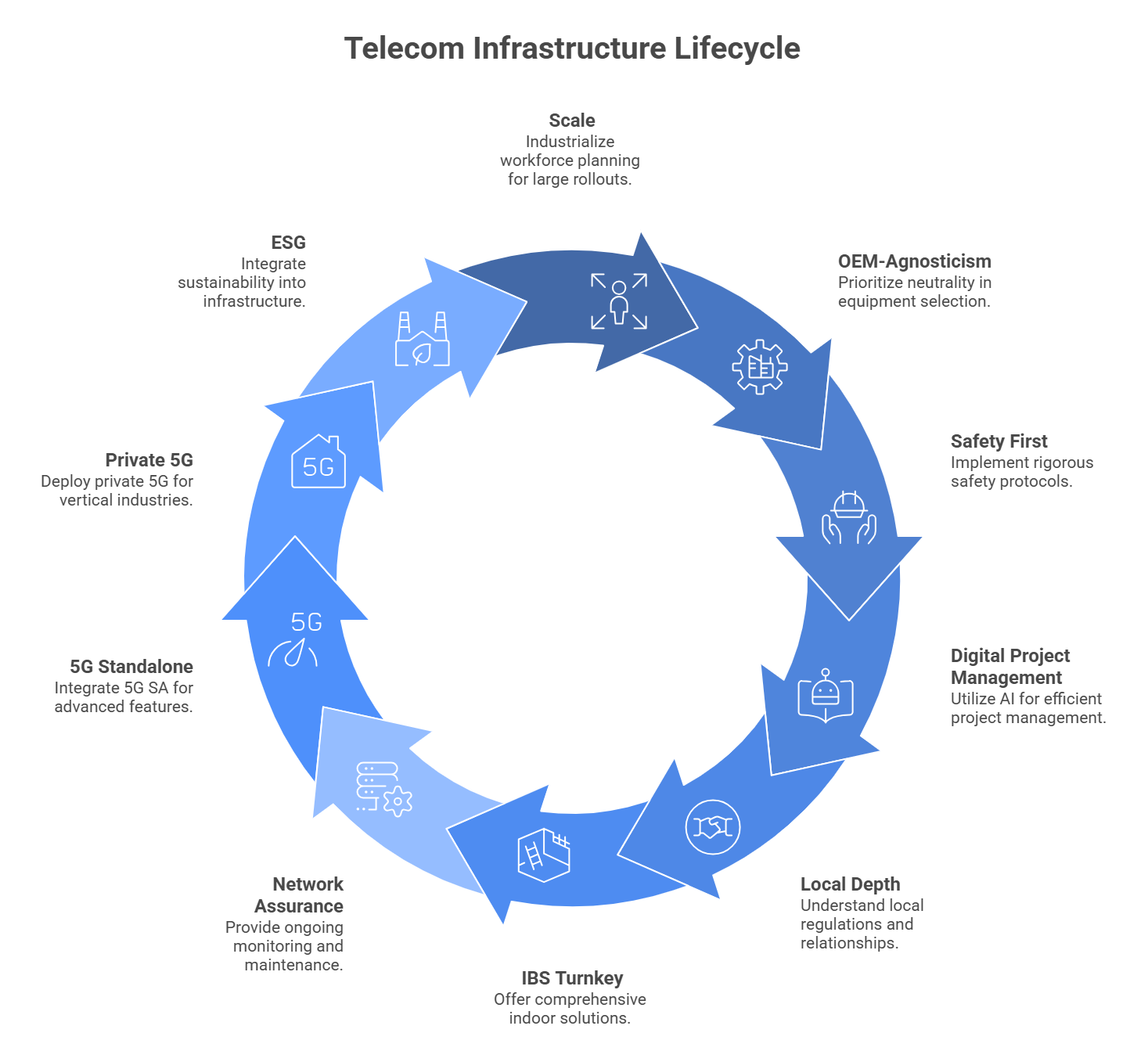
1. Scale: The Industrialization of Labor
A partner that excels at managing a hundred sites may fail when asked to manage five thousand across diverse topographies. High-volume rollouts require the industrialization of workforce planning. This means having rigid “quality gate” protocols where a site in a remote rural district receives the exact same multi-point check as a site in a major metro. Scale is not just about having “boots on the ground”; it is about the centralized logistics engine that ensures every nut, bolt, and radio unit is accounted for in real-time.
2. OEM-Agnosticism: The Key to CAPEX Optimization
Most major operators and large enterprises run a heterogeneous mix of equipment. To maintain a competitive edge, a “how to select telecom system integrator” strategy must prioritize neutrality. An agnostic partner’s engineers are equally comfortable commissioning hardware from any of the major global vendors. This neutrality delivers 15–20% lower CAPEX by allowing the operator to negotiate better deals with hardware vendors, knowing their integration partner can handle whichever platform wins the bid.
3. Safety First: The “Permit-to-Work” Discipline
In telecom field work, safety is more than a moral obligation; it is a daily operational metric. A single safety incident can trigger a complete regulatory shutdown of a project.
The Vedang Standard: We apply mandatory PPE & Digital Permit-to-Work (PTW) systems. By maintaining ISO 9001, 14001, and 45001 certifications, we ensure that every site visit is logged, audited, and performed under the highest safety protocols. This discipline is what allowed us to support India’s leading operators during the most aggressive 5G rollout in history.
4. Digital Project Management: The AI Revolution
Manual spreadsheets are the enemy of large-scale infrastructure. In 2026, the best partners use Automation Services to eliminate human error:
- AI/ML Remote Site Audits: Using computer vision to verify antenna height, tilt, and cable labeling via photos taken on-site, ensuring 100% compliance without sending a second supervisor.
- IoT Advantage: Real-time site monitoring can detect a power fluctuation or a cooling failure before it leads to a radio shutdown, moving maintenance from “reactive” to “predictive.”
5. Local Depth: Navigating the Terrain
Telecommunications is a local business. The process for municipal approvals in Delhi is fundamentally different from the requirements in the North East or the South. “Local depth” means your partner speaks the language, understands the geography (from coastal salt-air corrosion to mountain wind-loading), and has the established relationships to resolve Right of Way (RoW) disputes in hours, not months.
6. IBS Turnkey: The Future is Indoors
With 5G’s higher frequency bands (like C-Band and mmWave), signal penetration into buildings is a significant challenge. For high-rises, hospitals, and smart malls, outdoor towers are no longer sufficient. A partner must offer IBS (In-Building Solutions) Turnkey services managing everything from the initial radio frequency (RF) design and walk-test to the deployment of small cells, distributed antenna systems (DAS), and fiber-to-the-room.
7. Network Assurance: The Long-Term Lifecycle
The relationship with a rollout partner should not end the moment the site is commissioned. A partner with Network Assurance and O&M (Operations & Maintenance) depth provides 24×7 monitoring and “Drive Testing” to validate coverage. This ensures that the network is not just “switched on” but is actually meeting the throughput and latency targets required by the business case.
Redefining Infrastructure for Enterprise & Global Markets
8. The 5G Standalone (SA) Mandate
In 2026, the “Non-Standalone” era is effectively over. Enterprises are moving toward 5G Standalone (SA) because it is the only way to support Network Slicing. This allows a single physical network to be divided into multiple “virtual slices” one for emergency services with guaranteed priority, and another for low-power IoT sensors. Your partner must have the core-network expertise to integrate these logical slices seamlessly.
9. The Role of Private 5G in Vertical Industries
We are seeing a massive shift in who “owns” the network. In sectors like Mining, Ports, and Manufacturing, the network is now a mission-critical utility, similar to electricity.
- Smart Ports: Using 5G to coordinate Automated Guided Vehicles (AGVs) and remote-controlled cranes requires latency so low that even a 50-millisecond delay can cause an accident.
- Smart Cities: 5G-enabled streetlights and traffic management systems require “site hardening” ensuring equipment can withstand extreme weather and urban pollution.
- Smart Utilities & Metering: Smart meters deployed over private LTE and 5G networks enable real-time monitoring, outage detection, and predictive grid management. These large-scale IoT deployments require secure, reliable network infrastructure across both urban and remote regions.
10. ESG and the “Green Site” Standard
Energy costs are now the largest component of an operator’s OPEX. A forward-thinking rollout partner integrates Sustainability into the build phase. This includes:
- Solar Hybrid Power: Reducing reliance on diesel generators in off-grid or unstable-grid areas.
- Passive Cooling: Designing site shelters that use natural airflow to reduce the need for high-wattage air conditioning units.
- Recyclable Infrastructure: Using modular site designs that can be easily upgraded or repurposed, reducing electronic waste.
Navigating the Regulatory and Security Landscape
In a world of increasing geopolitical complexity, Network Sovereignty has become a priority. Global operators and enterprises must ensure their hardware and software supply chains are secure. A rollout partner must provide:
- Secure Supply Chain Logs: Verifying the origin of every component.
- Cyber-Secure Integration: Ensuring that the commissioning process doesn’t leave “backdoor” vulnerabilities in the network core.
- Regulatory Alignment: In India, this means strict adherence to Department of Telecommunications (DoT) guidelines; globally, it means aligning with bodies like the FCC or ETSI.
The Integration Advantage: Why the “System Integrator” Model Wins
It is vital to distinguish between a labor contractor and a system integrator.
- A Labor Contractor provides people to do a specific job (e.g., pulling a cable). The burden of coordination, quality control, and troubleshooting falls on you.
- A System Integrator provides an outcome. You provide a target such as “100% 5G coverage in a 500-acre refinery” and the integrator manages the survey, design, equipment procurement, civil works, and final performance testing.
For the complexities of 5G and the upcoming 6G research phase, the integrator model is the only way to maintain control over total cost of ownership. It places the burden of multi-vendor coordination on the partner, allowing your internal leadership to focus on high-level business strategy and customer acquisition.
How Vedang Cellular Sets the Global Benchmark
Vedang Cellular Services was built to solve the challenges of the world’s most demanding telecom market. Having partnered with all four major operators in India, we have moved beyond being a service provider to becoming a systemized execution engine.
Our presence in all 22 telecom circles is the foundation of our local depth, but our digital-first approach is what makes us a global-ready partner. We remain strictly OEM-agnostic, ensuring that our clients have the freedom to choose the best technology for their specific use case. By embedding AI-driven audits and ISO-certified safety protocols into every step of our process, we provide our partners whether they are national telcos or private enterprise giants total visibility and a verifiable record of quality.
Whether it is a massive 5G expansion or a complex “Industry 4.0” private network, Vedang brings the scale, the safety record, and the multi-vendor expertise required to deliver a network that performs from day one.