
A telecom system integrator is a specialised company that plans, deploys, and manages end-to-end telecommunications infrastructure by combining hardware, software, and services from multiple vendors into one cohesive, operational network. They act as the single accountable partner between operators and the field.
What Exactly Is a Telecom System Integrator?
That 40-word definition is accurate, but it barely scratches the surface of the operational reality. If you have ever managed a circle-wide rollout, you know that the real challenge is not deploying a single technology. It is coordinating dozens of interdependent systems, vendors, civil works contractors, spectrum conditions, and regulatory requirements, all simultaneously, across geographies that vary wildly in terrain, infrastructure maturity, and local capacity.
A network system integrator steps into precisely that gap.
In the Indian context, this complexity is amplified considerably. India’s telecom landscape is defined by heterogeneous networks, where a single operator might run Nokia radio equipment in Tamil Nadu, Ericsson gear in Maharashtra, and Samsung radios in parts of Punjab. The core network could be from one vendor, transmission from another, and the OSS/BSS layer from a third. Stitching these components into a seamless, performant network is not something an OEM sales team is designed to do. That is the integrator’s job.
A mature telecom infrastructure company in India provides far more than installation labour. It brings system architecture expertise, certified multi-vendor engineering talent, project governance frameworks, and the field-level depth to execute at scale across India’s 22 licensed service areas, commonly referred to as telecom circles.
The Core Services: How a Telecom System Integrator Delivers Value
1. Planning and Design: RF and Transmission Engineering
Every network that performs well was designed well before the first tower bolt was tightened. Planning and design is where a competent telecom rollout partner earns its credibility most visibly. This phase is the blueprint of the entire investment.
On the radio frequency (RF) side, this involves site acquisition support, propagation modelling, frequency planning, antenna tilt and azimuth configuration, and inter-site distance optimisation. For 5G, particularly in mid-band deployments, the propagation characteristics are fundamentally different from 4G LTE. Cells are smaller, interference patterns shift, and the densification requirements are significantly higher. A skilled integrator brings RF engineers who have modelled these environments in the real world, not just in a simulator. They understand how Indian building materials, urban density, and foliage impact signal penetration.
On the transmission side, this includes microwave planning, fibre route design, IP/MPLS topology planning, and synchronisation architecture. For 5G TDD deployments, timing accuracy is non-negotiable. If the synchronisation is off by even a few microseconds, the network experiences massive packet loss and interference. An integrator ensures the backhaul and fronthaul can handle the massive throughput demands while maintaining the ultra-low latency required for modern enterprise applications.
2. Deployment and Commissioning
This is the phase where plans become physical infrastructure, and it is where most risks materialise. Civil works, power systems, antenna installations, feeder and jumper connections, equipment mounting, grounding, and initial configuration all happen in parallel across thousands of sites.
A professional telecom system integrator India brings structured project management to this phase. At the scale Indian operators work, where monthly rollouts can reach tens of thousands of site-level activities, ad hoc approaches simply collapse. Systemised deployment frameworks are what keep timelines intact. This includes:
- Pre-installation Surveys: Ensuring the site is ready for the specific hardware load and power requirements.
- Material Logistics: Coordinating the delivery of multi-vendor kits to remote locations.
- Installation Quality: Ensuring that every connector is weatherproofed and every cable is routed according to strict SOPs.
- Commissioning: Navigating multiple vendor CLIs and management systems to bring the equipment online.
3. Operations and Maintenance (O&M)
Post-deployment, the network must be monitored and continuously optimised. O&M is where long-term network quality is either protected or eroded. In a country with India’s geographical spread, having a distributed O&M workforce with local knowledge is a business requirement.
A capable integrator provides preventive maintenance schedules to catch hardware failures before they impact customers. They also provide corrective maintenance with defined SLA response times, remote monitoring integration with the operator’s NOC, and spares management logistics. Increasingly, integrators are also expected to support network optimisation functions: KPI monitoring, neighbour relation management, load balancing, and interference mitigation. These activities directly impact end-user experience and, by extension, operator churn rates.
4. Quality Assurance and Performance Benchmarking
Deploying a network is one milestone. Certifying that it meets performance benchmarks is a separate, equally critical function. Quality assurance in telecom integration covers acceptance testing at the site level, cluster-level drive tests, and end-to-end KPI validation.
Parameters like Reference Signal Received Power, Signal to Interference and Noise Ratio, throughput, and call setup success rate are all validated before sites are formally handed over. Performance benchmarking goes further by comparing actual network performance against design targets and competitive networks. For CTOs and Telecom Heads, this data is directly tied to TRAI compliance reporting and internal board-level KPIs. An integrator that takes QA seriously saves operators from costly post-launch remediation.
The Value of Multi-Vendor Integration in a Diverse Network
In the Indian telecom landscape, networks are rarely “single-vendor.” A single operator often utilizes a mix of radio and core equipment from various global leaders to meet the specific needs of different circles.
While OEMs provide world-class equipment and dedicated support for their specific platforms, an independent system integrator offers a complementary layer of expertise focused on interoperability . Managing a multi-vendor environment requires engineers who are fluent in multiple platforms simultaneously.
Working with a partner experienced across the entire ecosystem ensures:
- Seamless Integration: Ensuring that hardware from different manufacturers works as one cohesive unit.
- Technical Flexibility: The ability to adapt deployment strategies based on the specific technical requirements of a project rather than a specific product line.
- Operational Consistency: Applying a single, unified project governance framework across all sites, regardless of which hardware is being installed.
This collaborative approach allows operators to leverage the best-in-class technology from their OEM partners while benefiting from the localized, field-level execution depth of a dedicated integrator.
5 Reasons Indian Operators Choose a System Integrator
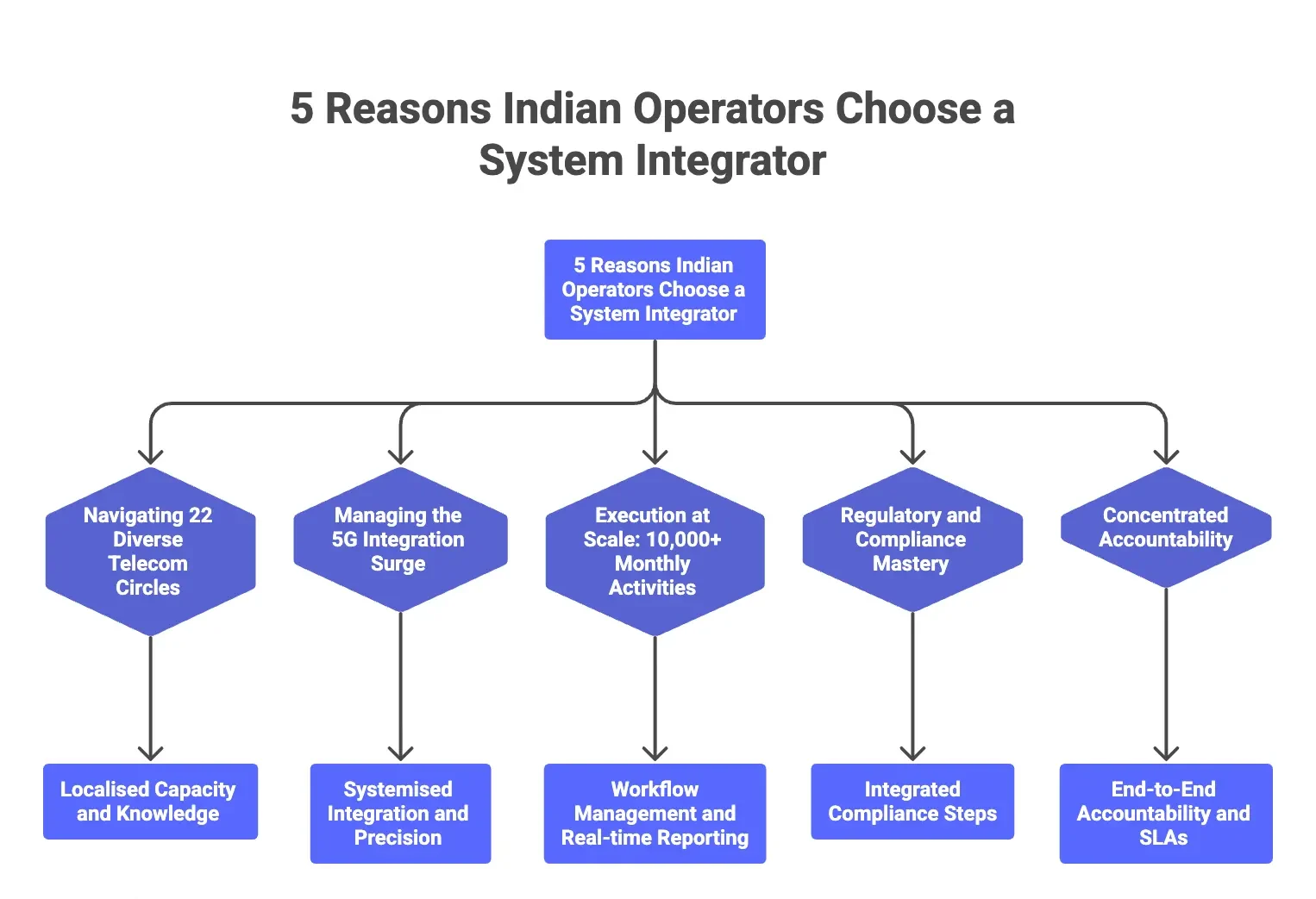
1. Navigating 22 Diverse Telecom Circles
India’s 22 licensed service areas are not uniform. Rajasthan and Madhya Pradesh present vast rural geographies with sparse infrastructure. Mumbai and Delhi are ultra-dense urban environments with acute tower real estate challenges. The North East circle involves difficult terrain and limited road connectivity. A national rollout programme requires localised capacity in each circle. This means local civil contractors, local RF engineers, and local regulatory knowledge. A seasoned telecom rollout partner maintains this circle-level presence, ensuring that a rollout in Bihar is as efficient as one in Karnataka.
2. Managing the 5G Integration Surge
5G network rollout is significantly more complex than 4G. It involves Massive MIMO antenna systems, Active Antenna Units with embedded radios, and RAN slicing configurations. Where a 4G site integration might involve fifty discrete technical tasks, a 5G site can involve over a hundred. This increased touchpoint density requires a level of precision that only a systemised integrator can provide. Without this methodology, error rates rise, and the time-to-market for new 5G services is delayed.
3. Execution at Scale: 10,000+ Monthly Activities
At the scale Indian operators work, managing high volumes of concurrent site activities is operationally non-trivial. Workflow management systems, real-time field reporting tools, and quality gate checklists are the architecture that makes speed and quality simultaneously achievable. A system integrator provides the heavy lifting required to manage thousands of monthly rollouts while maintaining a single point of truth for the operator.
4. Regulatory and Compliance Mastery
From TRAI’s Quality of Service regulations to the Department of Telecommunications EMF compliance norms, Indian telecom rollouts carry a dense regulatory burden. An experienced integrator knows these requirements intimately. They build compliance steps into the project workflow from the start, ensuring that every tower and every sector is compliant with local and national safety standards. This prevents legal delays and financial penalties during the rollout phase.
5. Concentrated Accountability
When a network underperforms, the blame game between equipment vendors, civil contractors, and power providers can be exhausting. A system integrator takes end-to-end accountability. You have one escalation point and one set of SLAs. For Telecom Heads managing cross-functional programmes, this accountability structure is operationally invaluable. It allows your internal teams to focus on strategy while the integrator focuses on execution.
Why Indian Businesses Need Localized Integration Expertise
The Indian market is unique because of its price sensitivity and its demand for high-quality service. Customers here consume more data per capita than almost anywhere else in the world. This puts immense pressure on the underlying infrastructure. A global system integrator might have the theoretical knowledge, but a local partner like Vedang Cellular understands the ground realities of Indian deployment.
Local expertise means knowing how to handle power fluctuations at rural sites. It means understanding the logistics of moving sensitive electronic equipment through monsoon-affected regions. It means having the relationships with local authorities to ensure that fiber laying or tower upgrades are not stalled by local bureaucracy. This “ground truth” is what separates a successful rollout from a project that is constantly over budget and behind schedule.
Furthermore, as India moves toward 6G and satellite-based connectivity, the role of the integrator will only expand. Integrating non-terrestrial networks with existing terrestrial 5G infrastructure will require a level of system thinking that goes far beyond simple equipment installation . At Vedang, we are already building the technical roadmaps and upskilling our engineering teams to bridge these new frontiers . Indian businesses need a partner who is thinking three years ahead, not just focusing on today’s site list.
How Vedang Delivers Integration Across 22 Circles
Vedang Cellular Services has built its reputation as a trusted telecom system integrator India by combining national scale with on-the-ground circle expertise. Across all 22 telecom circles, Vedang brings a consistent integration methodology and certified multi-vendor engineering teams.
Vedang’s engineers are trained and certified across all major vendor platforms, including Nokia, Ericsson, Samsung, and others . This multi-vendor fluency ensures that whether your network runs on a single platform or a combination of several, your technology decisions remain driven by your specific network strategy and operational needs
Rapid scalability is a core operational capability at Vedang. When operators need to accelerate rollout timelines during competitive launch phases, Vedang’s circle-level presence means capacity can be deployed quickly without the typical ramp-up delays. This localized depth ensures that every project, whether it is a small-scale enterprise private 5G network or a massive public network expansion, receives the same level of technical rigor and project governance.
Learn more about our approach at our telecom services page or discover more about us.